Sunday, April 28, 2013

Design Manifesto


Everything is shaped and designed by human purpose. Everyone is a designer—the decisions we make impact our environment and shape the world around us. From farming to choosing to the mow the lawn to the products we consume—all have some impact. As such, architectural form plays a huge role not only in function and look but in shaping the space and environment around it. As a designer, I have an especially unique opportunity to shape the way people experience the built world and the way they experience their everyday lives. Design can change the way we live, and in order to change the way we live, we must first start by changing the way we design.

This idea has been continually growing and changing since I first entered the college and has begun to shape and inform the way I design. I like to think of design as an opportunity to shape experiences and get people thinking more about what we can all do to begin reshaping the way we live. I love the idea that every decision is a design decision and the implications that can have on the entire process of design, from start to finish. Studying Charles Correa allowed me to start to stretch this idea in a different direction. His idea of complete integration--the many layers of design and how we must zoom in and zoom out as we reshape details and the big picture as a whole. Design is fundamentally about people, for people, and by people. 

In this sense, I align more with Ruskin than Viollet le Duc, although I don't necessarily align fully with his  ideals of craftmanship and individualism as an art form. I look at design as a response to context, to culture--to people. That is where individualism comes into the play. Each design problem requires a solution that responds to and solves the problem--perhaps a note to Mies van der Rohe's desire for design to respond to the fluidity of life, which for him resulted in the open plan. I probably identify most with Morris's ideals of uniting social and political issues and design. But each individual solution must also work within the larger context, although there is room for a break when trying to change the context itself--collaboration plus individualism. 

I am excited to see how these ideals--which have really just begun to form and and have just begun to shape the way I design--will begin to grow and change as I mature as a designer. Since I first started I have loved the idea of design being all about people, and I'm excited to expand upon this idea, to discover where the limits are and push beyond those.

Saturday, March 30, 2013

The Open Plan

Le Corbusier and Mies van der Rohe operated on specific design principles to help generate the architecture of their era. For both, their principles relied heavily on order and a method of organization that led to the formation and implementation of the open plan.

Le Corbusier designed from five principles known as the Five Points of Architecture: a pilotis elevating the mass of the building off the ground, the free plan as a result of load bearing columns, free facade, long horizontal sliding windows, and geometric clarity. The underlying method that led to Le Corbusier's development of the open plan was a system of order defined by his desire to relate art and industrialism as well as his desire to not be confined within the limitations of structure.
"No one today denies the aesthetic that emanates from the construction of modern industry...machines dispaly such proportions, plays of volume and materiality that many are true works of art, because they embody number, which is to say order." Le Corbusier admired the order of the machine of industrialization--the proportions, volumes materiality, etc. This penchant for order and freedom from structure manifested in a structure of floor slabs and columns, eliminating the need for load bearing walls. He changed the way architects were using reinforced concrete in building structure and used it as a means towards industrialization of the building process. Many of his colleagues used reinforced concrete as the main structure and showcased that in the facade. Le Corbusier hid the actual structure of columns and floor slabs beneath the facade in a system of structure and architectural aesthetics. By eliminating the need for walls to be load-bearing, he opened up their use for spatial formation and design.

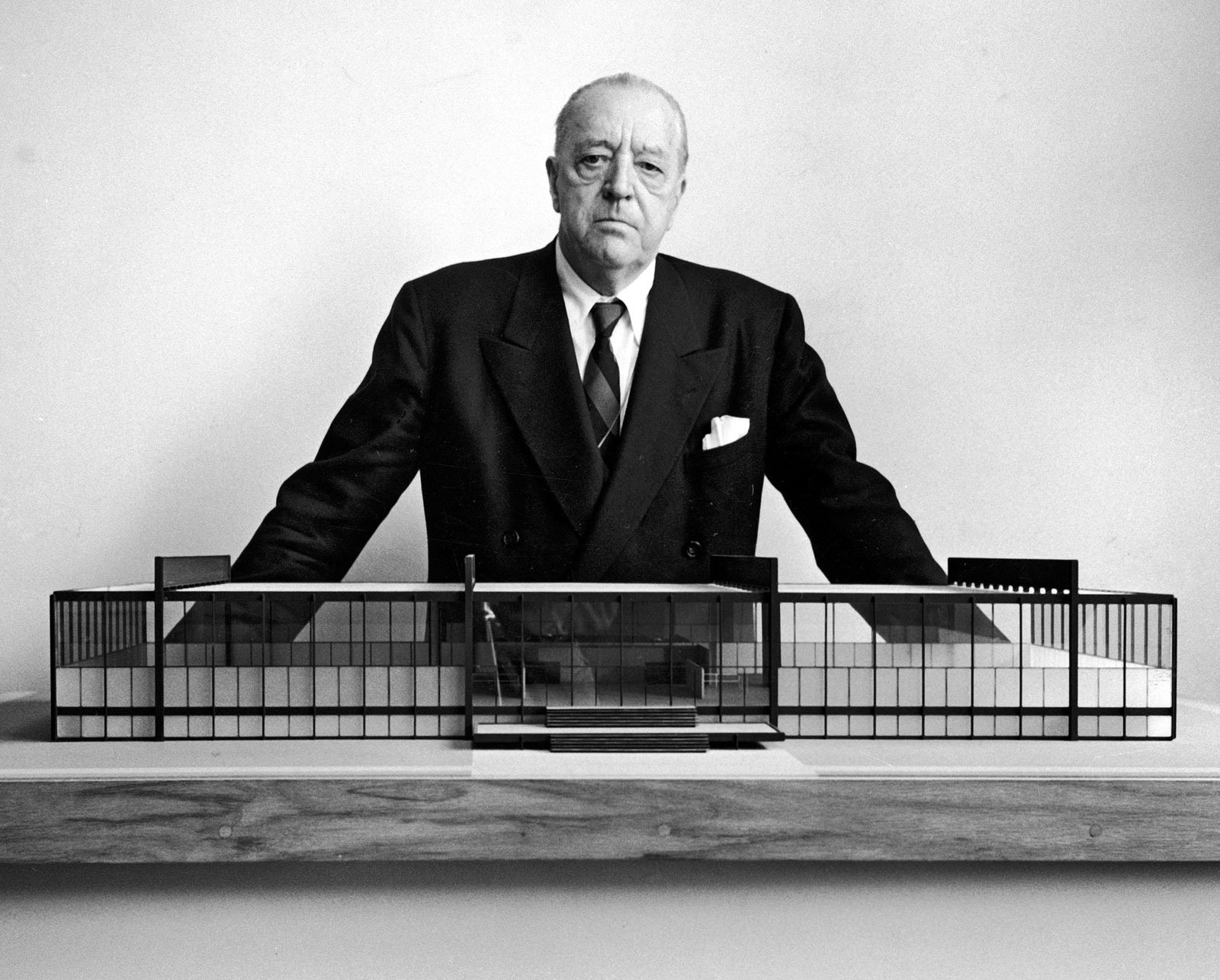
Mies van der Rohe operated on a set of principles as well: square or rectangular form, the articulation of buildings in response to the fluidity of life, dematerialization of architectural elements, plastic sensibility in window and brick composition, and elementalist design of the plan. For Mies van der Rohe, it was all about composition and the dialogue between the column, the wall, and materiality. He designed with utmost simplicity.

His desire for his buildings to respond to the fluidity of life necessitated the open plan. By using a column structure much like Le Corbusier, he designed his buildings so that the walls became design elements rather than structural component. Instead of responding to the the structural system, the walls could respond to "the fluidity of life" and conform to a design system rather than structural. He designed with the utmost simplicity, which was in fact a result of a long process of thinking, planning and organizing.

Although Mies van der Rohe and Le Corbusier both operated on a different set of principles and design thinking, their underlying desire to design outside of the confines of structure (with regards to interior spatial formation) united them in the development of the open plan within their building designs.

SOURCES:
Colquhoun, Alan. Modern Architecture. Oxford: Oxford UP, 2002. Print.
             Herz-Fischler, Roger. (1927). Le Corbusier's "Regulating Lines" For the Village at Garches and Other Early Architectural works. 
            Middeldorf, Ulrich. "Mies Van Der Rohe." College Art Journal 7.1 (1947): 34-35. JSTOR. Web.
http://redingote.fr/wp-content/uploads/2011/09/61926-050-F98DB706.jpg
http://42ndblackwatch1881.files.wordpress.com/2009/04/c-5.jpeg

Wednesday, February 27, 2013

The Emergence of Modern Architecture


The emergence of modern architecture grew from reactional design to the rising industrial age and the progression of society and culture, usually working within the framework of either individuality or collectivism.
            The Arts and Crafts Movement was one of the first in which the influence of the Industrial age began to shape the work of designers. They championed craftsmanship and the importance of how an artist produces designs within the framework of economic and social reform, all as a counter movement to Industrialization. Designers looked to nature as an example of God’s design and worked within a style associated with romantic, medieval fold decorative elements. In their minds, Industrialization was destroying the art of craftsmanship and the beauty of true design, which lay in the process and work of the individual craftsman. 
As the first systematic attempt to replace the classical system of architecture and the decorative arts, the Art Nouveau movement fit more cohesively within the Industrial Age. Although designs utilized craftsmanship like the Arts and Crafts Movement, the acceptance of industrial methods for mass production moved design and the philosophy behind it in a new direction. The focus on the creative process of craftsmanship was dropped for the industrial system. Artist originality and spirituality were stressed, but the importance of that expression did not extend throughout their entire school of thought, meaning it did not carry through to an avoidance of industrial mass production which works against that idea.
The De Stijl took this removal one step further, focusing on the machine made materials and uniform production. Designers used industrial methods to shape the experience of user in the relationships of spatial volumes, relating abstraction in the arts to architectural design.  Gone was the concept of the individual and in its place was the expression of the character of contemporary society as a whole. Design grew from universal values expressed from individual perception as abstraction. De Stijl emphasized uniformity in its simplification of the Cubist structure that worked within the frame of Industrialization but pushed for universalism.
The Amsterdam school, which coincided with De Stijl, operated on a different school of thought, drawing from the ideals of Ruskin, Morris, and the Arts and Crafts Movement. Designers did not view collaboration as particularly valuable and championed individualism, craft work, and traditional materials. They attached communist ideals and values to art and the ideal of a communal art. For the Amsterdam school, machines were useless and the individuality of the artist or architect was an important element in the creative process, believing that the betterment of society would come from contact with the arts stressing individuality.
Like the preceding movements, Russian Constructivism and Suprematism drew inspiration from the ideals of the contemporary culture and society. This movement operated within the Industrial Age and replaced the idea of individual identity with utopian ideals of a socialist commune state. Architecture was meant to represent the superiority of the state, to express the communal power of the masses and dominate building form. In this was lost individual identity, both in the creation and expression of architecture.
The Bauhaus movement continues this trace of of the communal environment, taking a utopian stance on the form and encouraging public exposure and social encounters through design. Bauhaus was greatly influenced by Industrial America, expressing the new society through design. Unlike Constructivism, the Bauhaus School of Thought, particularly Walter Gropius, looked to reconcile the individual and the community in a global vision of architecture. Within Bauhas, the Arts and Crafts Movement was reborn, featuring the same ideas behind design dressed in the garments of Industrialization.


SOURCES:

Images:
http://www.ruksliving.com/bauhaus.aspx
http://en.wikipedia.org/wiki/File:Noitrotsky.jpg
http://lisathatcher.wordpress.com/2012/04/10/gerrit-rietveld-furniture-and-architecture-and-design-and-de-stijl/


Monday, February 4, 2013

William Morris and 19th Century Architecture


           William Morris, a designer and manufacturer of crafts, largely influenced the Arts and Crafts movements and worked towards reshaping modern architecture in the 19th century.  He is considered one of the most versatile and influential designers of the Arts and Crafts Movement in England—a movement associated with social reform and romantic, medieval fold decorative style.
                Morris’s distaste for industry and his taste for fine art and high quality led him to be a strong supporter of the complete reform of industrial society. He believed in the union of social and political issues with design and worked to reform industry with his own model of business exemplified in Morris & Co. Through his model he emphasized relaxed working conditions and the creation of art. According to Morris, leisure involved four things: meeting a vocation, pleasant surroundings, a certain scope of variation, and usefulness. He believed in individual development, the abolition of the division of labor and better working conditions.
Morris’s vision of applying his values of high quality, crafted fine art to commercial design and production was key to the evolution of design. He believed there to be an uneven pattern of forced ownership in society that stripped production of the “expression by man of his pleasure in labour” that created true art. He once wrote: “what is an artist but a workman who determined that, whatever else happens, his work shall be excellent? Or, to put it in another way: the decoration of workmanship, what is it but the expression of man’s pleasure in successful labour?” For Morris, work was to be driven by two forces—nature (the need to make a living) and desire (love of art)—in order to produce his vision of society.
His value originality in design and his belief that art’s inferior quality was a product of poor quality of life pushed him to champion social, commercial, and design reform. His belief in nature as the perfect example of God’s design manifested itself in a common theme of nature-inspired designs such as the floral tapestry design below.

Morris brought quality and life to modern design with vision reminiscent of the ideals of John Ruskin. “No person is able to give useful or definite help towards the special applications of art, unless he is entirely familiar with the conditions of labour and materials involved in the work”—a sentiment Ruskin expressed that made a great impression on Morris. He shared Ruskin’s value of the decorative arts as well as his views on work and business morality. In Morris’s case he made efforts towards practical expression of those values through his business. Both Morris and Ruskin advocated social harmony over individual profit and believed in providing opportunities to give workman creative freedom. In the minds of Morris and Ruskin a happy worker in a beautiful environment led to the creation of beautiful things.
Morris’s impact shaped many designers’ perceptions and ideals of the quality of design in the industrial age and helped form the language of modern architecture in the 19th century.


Harvey, Charles and Press, Jon. (1995). John Ruskin and the Ethical Foundations of Morris & Company. Journal of Business Ethics, 14(3), 181-194. Retrieved from
http://www.jstor.org/stable/25072636
Kinna, Ruth. (2000). William Morris: Art, Work, and Leisure. Journal of the History of Ideas, 61(3), 493-512.  10.1353/jhi.2000.0027

Monday, January 21, 2013

Viollet le Duc, Ruskin, and Semper


Though similar in some of their beliefs and thoughts, the perspectives of Viollet le Duc, Ruskin, and Semper manifested in very different approaches to style in the 19th Century.

Viollet le Duc approached architecture rationally, studying the designer’s grip on the logic of rational construction. Like Ruskin, he greatly admired Gothic architecture, but for the rational he found behind the design rather than the virtues and aesthetics of the design. In Viollet le Duc’s mind there was a logical process behind the successful result of design—gothic architecture itself was not necessarily rational, but its style was made from ideas a subconscious working on rational parts that led to structure. Le Duc took his analyses and scientific expositions of Gothic architecture and then applied it to his own work. His approach to style and design involved studying the past, reducing it to a process of reason, and then applying it to his own work. This process and Viollet le Duc’s fascination with new materials, specifically ironwork, made him a very forward looking designer—but he did not implement his writings and bold convictions into his built design work.

Ruskin looked at architecture through a more emotional lens. His Seven Lamps of Architecture encapsulated his perception of architecture and design based on principles and morals. These “lamps” included: sacrifice, truth, power, beauty, life, obedience, and memory. In Ruskin’s mind, each of these lamps were to be a guiding light to design, an interesting approach as none of these were quantifiable. His admiration for Gothic architecture lay in his view that architecture was alive with life that the carver gave it. As such, the ornamentation and detail were true architecture (not necessarily the building itself), and naturalism and age were incredibly important. His belief in the holistic composition of elements (specifically, the holistic composition of his “seven lamps”) led him to never truly consider a new style. His strong beliefs in preservation and his view that age, craft, and the monumental made true architecture manifested into Ruskin’s confidence in existing styles as the styles of the modern day.

Semper operated on the conviction that “architecture everywhere borrowed its types from pre-architectural conditions of human settlement.” His approach was somewhat of a combination of Viollet le Duc and Ruskin. He studied architecture and artifacts in the context of ritual rather than aesthetic value from which he then formulated a new scientific design or “practical aesthetic. He looked for the meaning behind the building in order to better understand the processes of how to generate style (specifically in his Der Stil), which he broke down to a mathematical formula: U=C (x, y, z,…).  Semper’s aim was to establish a taxonomy of architectural style and form. He divided the built form into four categories he believed were consistent across time and cultures—heart, substructure or platform, roof, and enclosure. These “four basic elements” existed in every style, but their manifestation was shaped by socio-political and cultural conditions that would create the style of each age.


Sources:

Van Eck, Caroline. (2006). Nineteenth-Century Architecture and Theory: Gottfired Semper and the Problem of Historicism by Mari Hvattum. Journal of the Society of Architectural Historians, 65(1), 136-139. Retrieved from http://www.jstor.org/stable/25068251
Pevsner, N. (n.d.). Ruskin and Viollet-le-Duc. Englishness and Frenchness in the Appreciation of Gothic Architecture. (pp. 6-43). London: Thames and Hudson London.
Summerson, J. (n.d.). Viollet-le-Duc and the Rational Point of View. Heavenly Mansions. (pp. 140-159).