 Le Corbusier designed from five principles known as the Five Points of Architecture: a pilotis elevating the mass of the building off the ground, the free plan as a result of load bearing columns, free facade, long horizontal sliding windows, and geometric clarity. The underlying method that led to Le Corbusier's development of the open plan was a system of order defined by his desire to relate art and industrialism as well as his desire to not be confined within the limitations of structure.
"No one today denies the aesthetic that emanates from the construction of modern industry...machines dispaly such proportions, plays of volume and materiality that many are true works of art, because they embody number, which is to say order." Le Corbusier admired the order of the machine of industrialization--the proportions, volumes materiality, etc. This penchant for order and freedom from structure manifested in a structure of floor slabs and columns, eliminating the need for load bearing walls. He changed the way architects were using reinforced concrete in building structure and used it as a means towards industrialization of the building process. Many of his colleagues used reinforced concrete as the main structure and showcased that in the facade. Le Corbusier hid the actual structure of columns and floor slabs beneath the facade in a system of structure and architectural aesthetics. By eliminating the need for walls to be load-bearing, he opened up their use for spatial formation and design.
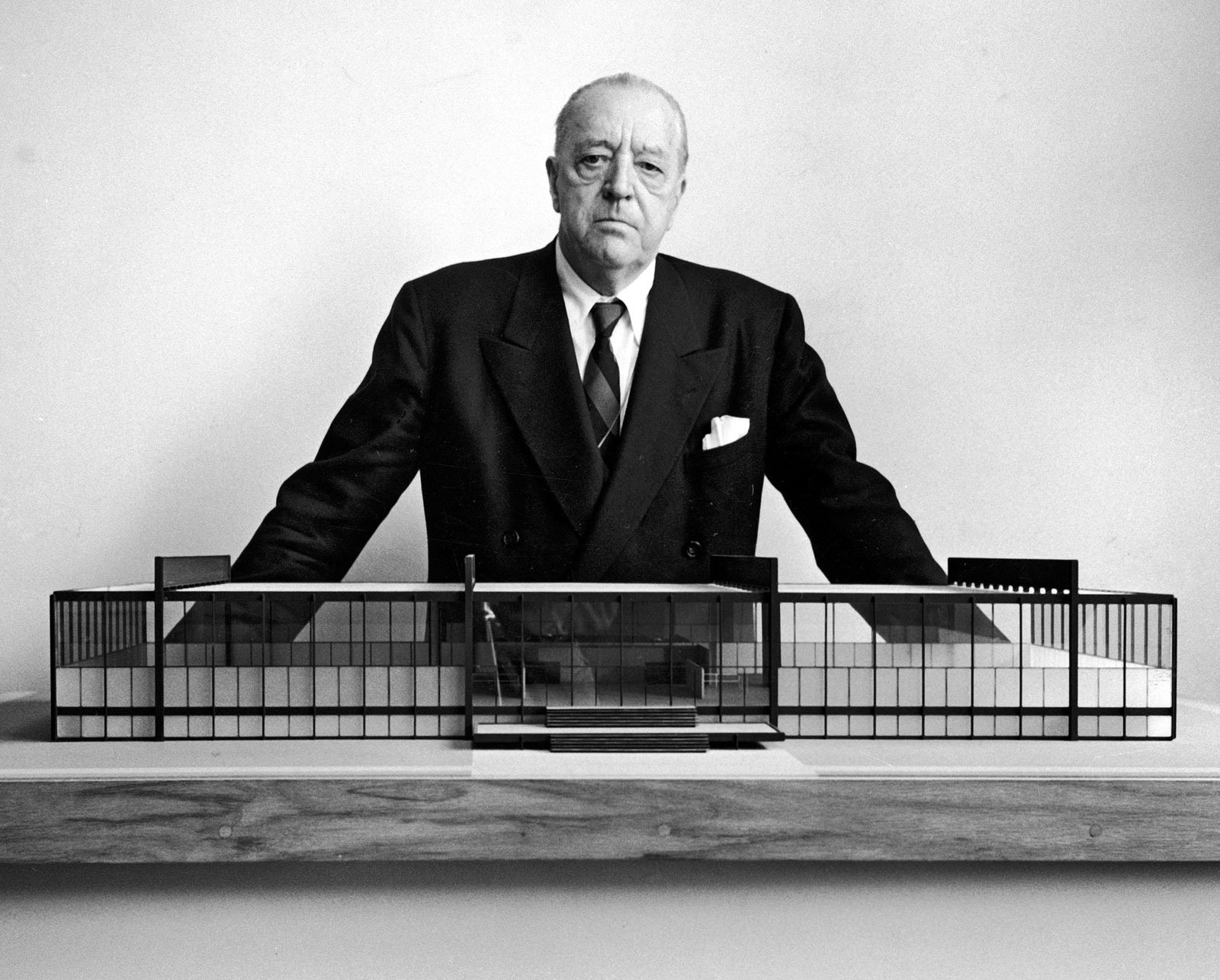 Mies van der Rohe operated on a set of principles as well: square or rectangular form, the articulation of buildings in response to the fluidity of life, dematerialization of architectural elements, plastic sensibility in window and brick composition, and elementalist design of the plan. For Mies van der Rohe, it was all about composition and the dialogue between the column, the wall, and materiality. He designed with utmost simplicity.
His desire for his buildings to respond to the fluidity of life necessitated the open plan. By using a column structure much like Le Corbusier, he designed his buildings so that the walls became design elements rather than structural component. Instead of responding to the the structural system, the walls could respond to "the fluidity of life" and conform to a design system rather than structural. He designed with the utmost simplicity, which was in fact a result of a long process of thinking, planning and organizing.
Although Mies van der Rohe and Le Corbusier both operated on a different set of principles and design thinking, their underlying desire to design outside of the confines of structure (with regards to interior spatial formation) united them in the development of the open plan within their building designs.
SOURCES:
Colquhoun, Alan. Modern Architecture. Oxford: Oxford UP, 2002. Print.
Herz-Fischler, Roger. (1927). Le Corbusier's "Regulating Lines" For the Village at Garches and Other Early Architectural works.
Middeldorf, Ulrich. "Mies Van Der Rohe." College Art Journal 7.1 (1947): 34-35. JSTOR. Web.
http://redingote.fr/wp-content/uploads/2011/09/61926-050-F98DB706.jpg
http://42ndblackwatch1881.files.wordpress.com/2009/04/c-5.jpeg
